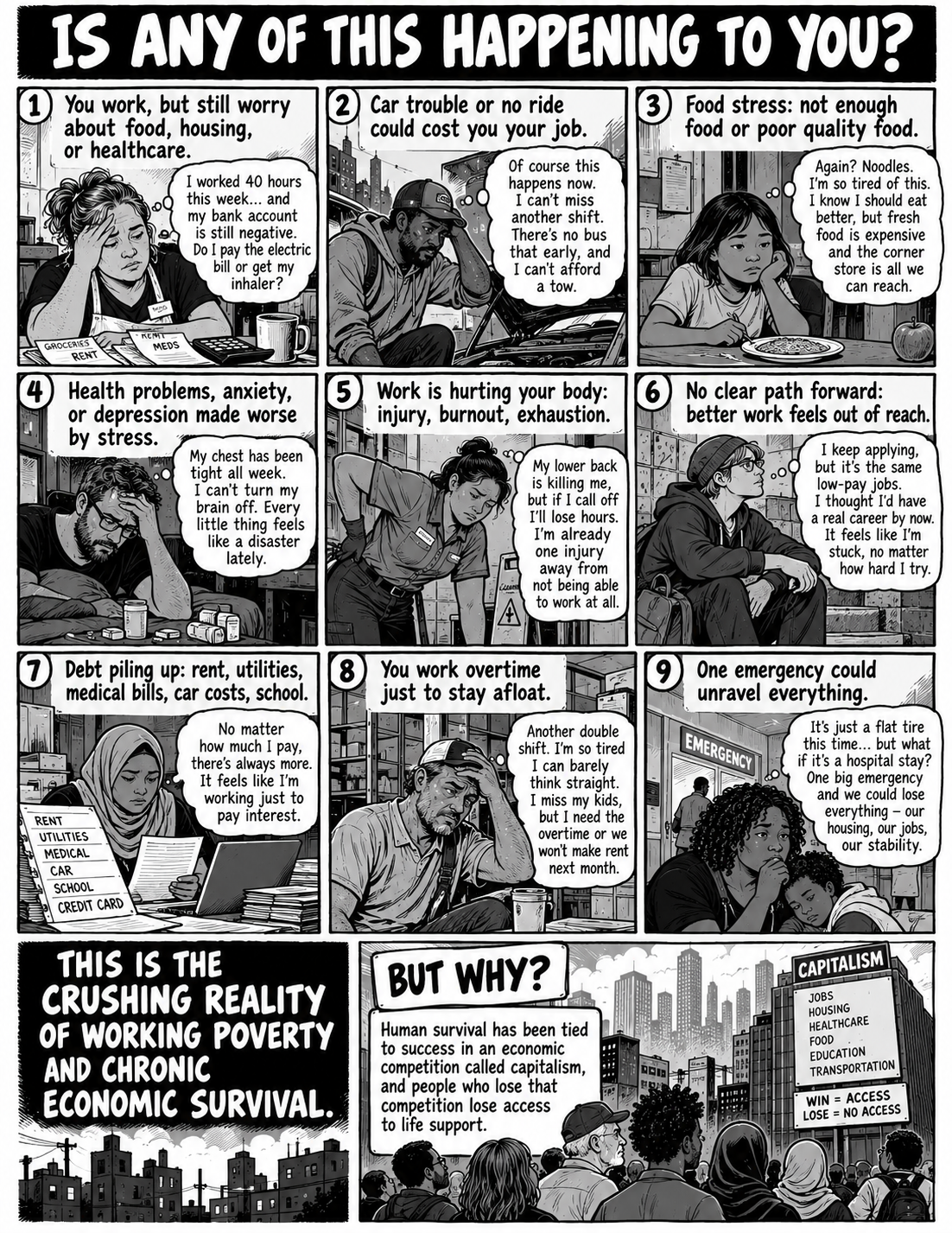
Is any of this happening to you?
You work, but still worry about food, housing, or healthcare
Car trouble or no ride could cost you your job
Food stress: not enough food or poor quality food
Health problems, anxiety, or depression made worse by stress
Work is hurting your body: injury, burnout, exhaustion
No clear path forward: better work feels out of reach
Debt piling up: rent, utilities, medical bills, car costs, school
You work overtime just to stay afloat
One emergency could unravel everything
This is the crushing reality of working poverty and chronic economic survival.
But why?
Human survival has been tied to success in an economic competition called capitalism, and people who lose that competition lose access to life support.
In capitalism, people compete for jobs, customers, resources, and opportunities. Competition can encourage innovation and efficiency, but it also means that access to income—and therefore access to food, housing, healthcare, and other necessities—is often tied to a person's ability to succeed in that competition.
Everyone must work in some way to meet their needs. The criticism is not that people have to contribute to society, but that most people must do so on terms largely controlled by owners of capital (stockholders and billionaires for example). If a person cannot find work, cannot compete effectively, becomes disabled, lacks education, or simply loses in the economic competition, they will struggle to access basic necessities.
Critics argue that this creates a situation where survival itself becomes competitive. They believe that food, housing, healthcare, education, and other essentials should not depend entirely on a person's success in the marketplace.
Supporters of capitalism respond that competition encourages productivity and creates wealth, and that the solution is not to eliminate competition but to ensure a strong safety net so that losing a competition does not mean losing access to life's necessities.
The safety net has failed.
Competition should not determine access to basic needs.
Capitalism itself is no longer an appropriate economic system.
Exit Strategy From Capitalism
This is a call to coordinate efforts.
Many people are already resisting capitalism in different ways.
The problem is not effort—it is LACK OF ALIGNMENT
This plan is simple:
On September 11th 2030:
At the same time, all people across the globe stop participating.
No work
No bills
No paying for basic needs
When done together, this disrupts the system immediately.
What Happens After That
For this to work, three systems must already be growing:
Mutual aid (meeting immediate municipal needs)
Critical trades (food, water, utilities and communication infrastructure, healthcare, other life support)
Resource management (materials, land, logistics)
As supply runs low, these systems take over distribution and production.
Your Role Right Now
Do not wait for a start date. Preparation comes first.
Learn the plan
Join or build a mutual aid network
Identify your role in critical trades or support
Share this message with at least five people who will pass it on
Here is the exit strategy in four steps:
This strategy depends on the three systems outlined above. The following steps explain how to build and align them.
To exit the capitalist system, we must refuse to participate at the same time. This means employing the strategy below and conducting mass refusal within the same time period.
Build Awareness
Understand capitalism
Understand this plan
Spread this website to people who are ready to make a radical shift
Parallel Structures
We need an economic system ready to replace capitalism.
Most alternatives include three elements:
Mutual aid
Critical trades
Resource management
Mutual Aid
Continue building capacity by bringing in municipal neighborhoods. If you do not belong to a mutual aid network, find one as close to your neighborhood as possible.
Critical Trades
Remember the COVID lockdown: only essential roles continued—those producing, procuring, and delivering vital goods and services. These roles remain necessary in a post-capitalist economy.
Resource Management
This is critical for long-term transition. It includes control and coordination of raw materials, land, and infrastructure. Once organized, distribution can be managed through apps and communication systems.
Mass Refusal
Once awareness is built and parallel systems are in place, coordinated refusal becomes possible.
The simple math:
Capitalism depends on steady transactions. Every transaction gives a billionaire a cut. Income streams require constant participation.
Levels of involvement
Defense against state pushback
Ethical sabotage
Product liberation
Full-time mutual aid and resistance support
Escalating mutual aid
Part-time mutual aid until transition begins (then full time)
Part-time mutual aid until transition is established
“Full time” and “part time” mutual aid refers to employing your labor to the transition (full time) or remining in the capitalism structure until the transition is more developed (part time).
Co-opt Infrastructure
Power and utilities (immediately)
Communication (imminently)
Emergency response (immediately)
Supply lines (imminently)
Labor Pool
Understand your current role
Determine if it fits the definition of “critical trade”
If yes, continue your role after the transition
If no, identify which critical trade your skills can support
Or
Shift into full-time mutual aid or community support roles
Heavy Lifts
Medical system (likely the easiest to transition)
Legal system
Government system
Education system
Exiting capitalism is simple in concept, but requires coordination, preparation, and trust.
We existed and lived in cooperation long before capitalism. The problems it claims to solve can be addressed through other systems.
Capitalism is not necessary for human survival or coordination.
Please send feedback to wecanendcapitalism.org
Or use the feedback page here: